
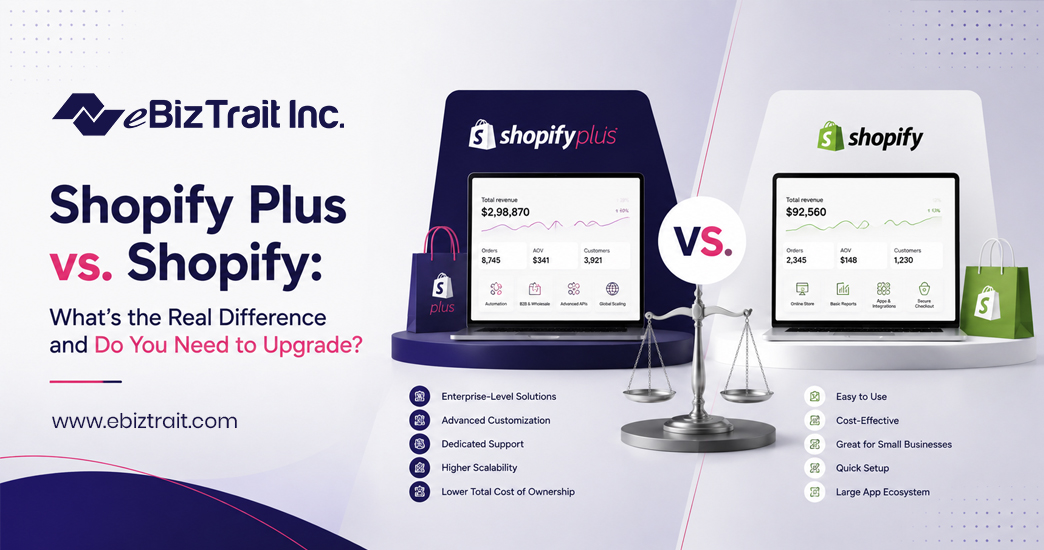
Online stores growing rapidly are faced with the question of whether they should transfer to Shopify Plus. Before you make a decision and switch to this upgraded version of Shopify, you have to get an overview of the options available, the costs involved, and most importantly – whether your online store really needs this upgrade.
Read this article to find out what Shopify Plus can offer in comparison to Shopify and most importantly whether your online store will benefit from the change to Shopify Plus.
Shopify vs. Shopify Plus: The Basic Distinction
This Standard Shopify is designed for small to mid-sized online stores and has all the basic features that you would expect from a merchant’s site (i.e. store front, check out, payment processing, inventory tracking, etc.) plus it has access to the App Store to get additional apps as needed.
The enterprise-level plan for high-volume merchants, for multi-brand shops and for shops with complex operational requirements. With Shopify Plus you get more control over the checkout process, more automation options and better multi-store management. On top of the regular features of a Shopify plan, you also get dedicated support.
Now that we understand what Shopify and Shopify Plus are, we can discuss the three main factors that distinguish between the two: pricing, features, and scalability.
Shopify Plus vs Shopify Pricing
First is the cost of the Shopify plans. This is typically the first thing that any merchant wants to know about.
Our basic Shopify plan and higher levels, including Shopify and Advanced Online Store, are priced on a monthly basis, with increasing cost as you go from Basic to higher levels. A transaction fee is charged on sales until you are using Shopify Payments, however, this can be easily added to your online store. The monthly cost for each of our Standard Online Store plans is low and fixed, ensuring that you always know what to expect.
Shopify Plus is generally negotiated on a per-case basis. There is a typical structure to the pricing though: the standard Shopify plans have a fixed monthly fee for the platform, but the Shopify Plus pricing includes a fee based on the sales volume of the store, typically in the form of a percentage of revenue once the revenue for the month crosses a certain threshold.
Comparing Shopify Plus pricing with Shopify plans is often not a matter of the two plans having different rates for similar services. Instead, the additional cost for Shopify Plus needs to be compared with the additional services and increased opportunities for revenue, that the upgraded store operations will bring. The checkout customizations for high volume stores for example can quickly pay for the high cost of Shopify Plus many times over.
Shopify Plus vs Shopify Features
This section outlines the differences in functionality between Shopify and Shopify Plus.
Checkout Customization
Limited checkout customization. Checkout branding is adjustable, however there is very limited ability to alter the underlying checkout logic or add custom scripts to the checkout.
By enabling Functions in the checkout, merchants can extend and customize the checkout to include a wide range of features and logic. For example, upselling to customers, including dynamic shipping and payment options, creating complex business rules and more. The checkout is one of the highest converting parts of an online store, and having the ability to make meaningful changes here can have a significant impact on conversion for high volume transaction merchants.
Automation
Shopify Plus comes with the automation tool Shopify Flow, which can for example create workflows for inventory, orders, customer tagging, fraud checking, etc. Without any need for developers, Shopify Flow makes it possible to change processes and set up new flows of actions within minutes. On the Standard Plan, you can set up very limited automation, for which you often have to rely on third party apps, to get the same results.
Multi-Store Management
Merchants with multiple storefronts (e.g. different regions, different brands, etc.) can manage up to nine stores from within one organization, with shared resources and reporting. This is not possible with Standard Shopify plans, as each plan is for a single store.
B2B and Wholesale
Wholesale/B2B Functionality: On Shopify Plus, merchants can run their B2B (wholesale) operations in addition to their direct-to-consumer online store(s) all from within the one backend. This is to be contrasted to Standard Shopify where B2B functionality (wholesale) is not natively available and would require the merchant to get a third party app to work around the limitation.
API Limits and Customization
Shopify Plus merchants get significantly higher API rate limits. This is important for a number of reasons, but mainly because a high API rate limit is required. For the custom integration that many larger Shopify stores require. Also, the amount of apps installed by a merchant in large shops can become a problem quite fast.
Support
Priority Support is included for Shopify Plus plans. With this, you get dedicated Merchant Success Managers to support you and help you with any issues you have. With Standard Shopify plans, you get the general support queues to deal with any issues that may arise. Which can cause problems when your store is experiencing very high volumes of transactions.
In summary, all these Shopify Plus development differences together actually describe a shift from a self-serve platform. For an infrastructure and support platform designed to handle complex, high-volume online stores.
Shopify Plus Comparison: Who Actually Needs It?
Not every growing store needs Shopify Plus. Upgrading too early will cost you the price of an enterprise plan for features you are not using yet. Here is a framework to consider when.
You likely don’t need it yet if:
Your monthly revenue is still well below six figures.
You’re running a single storefront with straightforward operations
Your current checkout and automation needs are being met with apps
You haven’t hit API rate limits or app performance issues.
You’re a strong candidate for that if:
Your store processes a large number of orders per day. And there are a number of customizations to the checkout that are not currently available.
You manage multiple brands or regional storefronts
You need robust wholesale/B2B functionality alongside your DTC store.
You need robust wholesale/B2B functionality alongside your DTC store
You’re a strong candidate for Shopify Plus if… (3)
You’re planning aggressive growth and want infrastructure that scales with you
A good rule of thumb to test whether you would be better off switching to Shopify Plus immediately is to check whether you are currently “glueing together”. A few different apps in order to create a comparable set of custom checkout, automated processes and/or multiple stores. They are already offered as native features within Shopify Plus. If the answer is yes, it will cost you less and be more efficient in the long run.
Making the Decision
The decision to choose Shopify Plus over the Shopify platform has nothing to do with which platform is better for growing online stores. There are plenty of growing online stores on the standard Shopify plan and they remain there successfully. What is more important is to determine where your growing online store actually. Then choose the correct platform to move your store forward.
Map out what is holding back your growth. Is it flexible checkouts, automation of certain tasks, the ability to run multiple stores, or extremely fast support? Then Plus might be worth your while to investigate further. However, if your growth is held back by other factors such as lack of traffic, low conversion rates, or an incorrect product/market fit. Then spending money to upgrade your Shopify store plan will not fix these issues.
FAQs
1. What is the main difference between Shopify and Shopify Plus?
Shopify Plus is the enterprise-level plan, offering deeper checkout customization, built-in automation, multi-store management, native B2B tools. And dedicated support features not available on standard Shopify plans.
2. How much does Shopify Plus cost compared to standard Shopify?
Standard Shopify plans have fixed, relatively low monthly pricing. Shopify Plus pricing is typically customized based on sales volume, often combining a monthly platform fee with a revenue-based component once you exceed a certain threshold.
3. Do I need Shopify Plus if I’m just starting out?
No. Shopify Plus is built for high-volume, complex operations. New or small stores are almost always better served by a standard Shopify plan until they hit real scaling friction.
4. Can I customize checkout on standard Shopify plans?
Only in limited ways, such as branding elements. Full checkout customization, including custom logic and dynamic upsells, requires Shopify Plus’s checkout extensibility features.
5. Does Shopify Plus support multiple stores?
Yes. Shopify Plus allows you to manage multiple storefronts under one organisation. This is especially useful for multi-brand businesses or companies operating in several regions.
6. Is Shopify Plus worth it for B2B and wholesale businesses?
Often, yes. Shopify Plus includes native B2B functionality, letting you manage wholesale and direct-to-consumer sales from a single backend.
7. What kind of support do Shopify Plus merchants get?
Shopify Plus merchants get a dedicated Merchant Success Manager and priority support. Compared to the standard support queues available on regular Shopify plans.
8. Will upgrading to Shopify Plus automatically increase my sales?
No. Shopify Plus provides infrastructure and tools to support scale, but it doesn’t directly drive traffic or conversions. Those still depend on your marketing, SEO, and on-site optimization.
9. How do I know if my store has outgrown standard Shopify?
Common signs include hitting API rate limits, needing checkout customization apps can’t provide. Also managing multiple storefronts manually, or outgrowing standard support response times.
10. Can I switch from Shopify Plus back to a standard plan later?
Yes, it’s possible to downgrade. Though it typically involves reconfiguring certain features and workflows built specifically for Plus, so it’s worth confirming the details with Shopify before switching either direction.
