
There are many resources available today that cover the ways to enhance the shopping experience online, as well as to increase the speed of the online store and flexibility of the design. One of the terms you will most likely encounter in the course of reading is the term ‘headless commerce’. Yes, it is a technical term; however, it can be explained easily. In the article below, we will also explain what ‘headless Shopify’ is, how it works and should you implement it for your online store.
Understanding Headless Commerce First
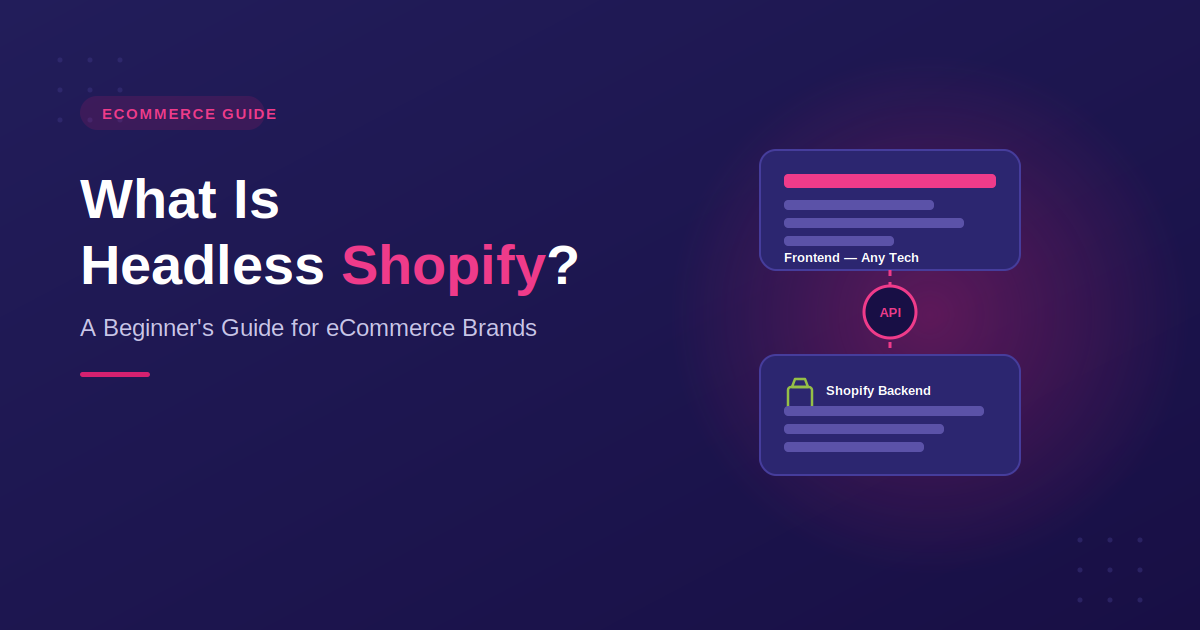
While this post will dive deep into Shopify, it’s worth understanding the larger landscape of “headless commerce” before we begin. Simply put, headless commerce refers to a ecommerce architecture where the frontend (your site, your app, your PWA, etc.) is separate from the backend (where your products, orders, and customer info live). Typically, an ecommerce site is a single, monolithic unit – the frontend and backend are one, and changing one often changes the other.
By breaking the front end and back end apart, but having them talk to each other via API, headless commerce allows for complete redesign of the front end of a site (the customer facing aspect) without touching the back end. This allows the back end of the site (where all the products, orders and customer information are stored) to keep running as normal, whilst the front end of the site can be completely re-designed, re-built and even run off a separate platform. It also allows the back end of a site to be used to power a number of different front ends including websites, mobile apps, smart TV apps, and even in-store kiosks, all serving up the same product information and order data.
This is the main benefit of the headless commerce approach, which is why so many e-commerce companies are now also exploring the method for their growing online business.
What Is Headless Shopify?
Headless Shopify refers to the application of the headless concept to Shopify. Instead of using Shopify’s native theme functionality to control how your Shopify Storefront will look and function, a headless Shopify setup treats Shopify purely as the backend commerce engine (managing products, checkout, stock, orders etc.). The front end of your website is created entirely separately to manage the customer experience.
That front end is typically built using modern web application frameworks (e.g. React, Next.js) that can query Shopify’s Storefront API to fetch the most up-to-the-minute product information, pricing and inventory in real time. What’s more, the experience can be customised in any way the developer wishes, giving them complete flexibility to deliver the best experience to customers.
To break it down even further, Shopify is still running the store in the background but now your site is only limited by your development skills and the design you wish to implement.
Why Brands Are Moving Toward Headless Shopify Development
Headless Shopify is another variation on the theme. Rather than using Shopify as a theme-enabled online store, Shopify is used purely as a back-end or commerce engine. The online store’s ‘front-end’ or customer facing part is completely separate and is typically built from scratch by a developer to deliver the best possible customer experience.
A Headless Shopify storefront is typically built using modern web application frameworks such as React, Next.js and others. Shopify has also developed a framework called Hydrogen that is specifically designed to power a Headless Shopify store. This front end can then connect to Shopify using the Storefront API to retrieve products, pricing and inventory in real time. The front end can then be designed and built to display this information in whatever way the developer sees fit.
Think of Shopify as running your store in the background, while your website is being powered in the front by a website built by you or your team, to exactly how you want it to look and function. No longer limited by Shopify’s theme structure.
The Technical Side: What Headless Shopify Development Involves
Headless is not a simple switch, it is a full development project. Here is a general overview of what it means to go headless.
Choosing a front-end framework. For most headless Shopify builds, the chosen front-end framework will be a React-based framework (e.g. create-react-app). Many will choose to use Shopify’s own Hydrogen framework, for the obvious reason that it was built specifically for headless Shopify builds.
Connecting to the Storefront API. This API retrieves data (e.g. product, collections, checkout) from Shopify and passes it to the custom front end to render.
Building custom front-end components (e.g. Product, Cart, Navigation, Search, etc.) for every part of your store (e.g. individual pages within Product Collections). This would mean building out every theme section from scratch.
The Headless storefront is hosted separately to Shopify and typically hosted on platforms such as Vercel or Netlify with separate deployment processes and requirements for ongoing maintenance.
Ongoing maintenance. Because the front end and back end are decoupled, there is a greater need for technical management to ensure that updates to the front end and back end are made to work together properly.
The complexity of going headless for most brands equals building out a fully functioning development project that is typically outside of their expertise and staffing capabilities. Typically brands require a strong in house team of developers in order to tackle a headless build in house.
Finding the Right Headless Shopify Developer or Partner
To work with headless commerce requires specific know-how. Therefore, you are better off working with an experienced headless Shopify developer or a specialized headless Shopify development company for your project.
For successful headless implementation, an experienced headless Shopify developer or a dedicated headless Shopify development company is a huge asset for a project.
Modern JavaScript frameworks like React and Next.js
Shopify’s Hydrogen framework and Storefront API
API architecture and performance optimization
Headless CMS integration, for cases where you need to manage a lot of content as well.
Ongoing support after launch for the typically more complex headless store compared to typical themes.
When evaluating potential providers of headless Shopify development services, it is especially important to find out about their previous experience with past headless projects rather than typical Shopify themes developed with traditional methods and tools. The set of skills for building headless commerce sites is very different from typical Shopify theme development.
Is Headless Shopify Right for Your Brand?
Headless Shopify is not the right solution for every shop. Typically, it makes sense for the following companies:
Have outgrown what standard Shopify themes can offer
Need highly custom design or interactive experiences
Sell across multiple sales channels and have all of your back end data in one place.
Have sufficient budget to sustain maintenance costs and have appropriate technical resources to sustain support.
Their current Shopify theme is performing poorly and would greatly benefit from a decoupled architecture.
For smaller online shops or new start-ups a well built traditional Shopify store or Shopify Plus theme is likely to be more appropriate, easier to manage and get up and running quicker than a Headless Shopify solution. Headless Shopify really comes into its own when a brand has very specific creative or technical requirements that cannot be achieved by a standard theme.
Final Thoughts
Headless Shopify is a powerful way to create a flexible and high performing online store. However, the flexibility also creates additional complexity. Understanding the basics of how a Headless Shopify site works, how the front end of the site is separated from the back end, the different tools that are used to power a Headless site, and what type of development support you will need to power your site is critical to helping you decide if a Headless Shopify site is right for your business.
If you decide to proceed with a Headless Shopify store, it is imperative to pair up with a skilled shopify development company that specializes in Headless Shopify builds to ensure that your store is running optimally.
FAQs
- What is headless in Shopify?
Headless means separating Shopify’s backend (products, orders, checkout) from the front end (the website design). Instead of using Shopify’s theme system, a custom-built front end pulls store data through APIs, giving brands complete freedom over design and user experience. - How much does headless Shopify cost?
Cost varies based on design complexity, features, and the framework used. Since everything is custom-built rather than theme-based, headless projects generally cost more than standard Shopify stores. It’s best to get a detailed quote based on your specific requirements. - What is the difference between Shopify Liquid and headless?
Liquid is Shopify’s built-in templating language used to build traditional themes within Shopify’s structure. Headless replaces this entirely with a custom front end built using frameworks like React or Next.js, offering more flexibility but requiring more development work. - How does a headless Shopify work?
Shopify handles the backend, products, inventory, checkout, and orders. A separate front end, built with tools like React or Hydrogen, connects to Shopify through the Storefront API to display products and handle customer interactions, giving full design control. - What are the benefits of using a headless approach for Shopify?
Benefits include faster page speed, full design freedom, consistent data across multiple channels like apps or kiosks, and better handling of high traffic. It’s ideal for brands needing custom experiences beyond what standard themes can offer. - How do I migrate an existing Shopify store to a headless architecture?
Migration involves keeping Shopify as the backend while building a new custom front end using frameworks like Hydrogen or Next.js. Product, customer, and order data stay connected through APIs, so nothing is lost, but the storefront is rebuilt from scratch. - Is Headless Shopify suitable for every business?
No, it’s not for everyone. Headless works best for brands with specific design needs, multiple sales channels, or performance issues on traditional themes. Smaller stores or those just starting out are usually better off with a standard Shopify setup. - Does Headless Shopify improve SEO?
It can, mainly through faster page load times, which search engines favor. However, SEO benefits depend on proper implementation, like clean URL structures and metadata, since headless builds require developers to set these up manually rather than relying on theme defaults. - Can I migrate my existing Shopify store to Headless Shopify?
Yes, migration is possible without losing your existing data. Shopify continues managing products, orders, and customers in the backend, while a new custom front end is built separately. Working with an experienced developer helps ensure a smooth transition. - Which businesses benefit the most from Headless Shopify?
High-growth brands, businesses selling across multiple channels (web, app, in-store), and companies needing highly custom design or interactive experiences benefit most. It suits teams with the technical resources to manage ongoing development and maintenance. - What technologies are commonly used with Headless Shopify?
Common tools include React, Next.js, and Shopify’s own Hydrogen framework for the front end, along with the Storefront API to connect to Shopify’s backend. Hosting is often done through platforms like Vercel or Netlify.
